
Carbohydrates for Fighters: Fuel Performance Without Compromising Weight Management
Carbohydrates are often one of the first nutrients fighters reduce when trying to make weight.
Sometimes this is appropriate. The problem begins when carbohydrate restriction becomes excessive and is maintained while the athlete is still expected to spar, complete conditioning sessions, lift weights, and maintain a high overall training load.
For combat sports athletes, the question should not simply be:
“Should I eat fewer carbohydrates?”
A better question is:
“How much carbohydrate do I need to support the training I am doing today?”
Understanding this difference can help fighters manage body mass without unnecessarily compromising the quality of their training.
Why Do Fighters Need Carbohydrates?
Combat sports are metabolically complex.
A fight is not purely aerobic or anaerobic. Athletes repeatedly move between lower-intensity activity and explosive actions such as combinations, kicks, takedowns, scrambles, clinch exchanges, defensive movements, and rapid changes in direction.
Carbohydrate stored in the muscles and liver as glycogen provides an important source of energy during moderate- and high-intensity exercise.
This becomes particularly relevant during demanding sessions involving repeated high-intensity efforts.
Current combat-sport nutrition guidance therefore supports maintaining sufficient carbohydrate availability during fight camp rather than simply removing carbohydrates as aggressively as possible.
Carbohydrates Are Not the Same as Body Fat
This is one of the most important concepts for fighters to understand.
Reducing carbohydrates can produce a relatively fast reduction on the scale.
But that does not mean all of that weight came from body fat.
Muscle glycogen is stored together with water. When carbohydrate availability and glycogen stores decrease, associated body water can also decrease.
This is one reason why manipulating carbohydrate intake may be used strategically during fight week.
However, acute scale-weight reduction and long-term fat loss are not the same physiological process.
A fighter should therefore avoid judging the success of their entire nutrition strategy solely by how quickly body weight falls after reducing carbohydrates.
Should Fighters Eat High Carbohydrate Every Day?
Not necessarily.
A fighter's carbohydrate requirements should reflect the actual demands being placed on the body.
Consider two days:
Day 1
-
Hard sparring
-
Conditioning
-
High training volume
Day 2
-
Technical training
-
Low overall intensity
-
Lower training volume
The nutritional demands of these days are not identical.
Carbohydrate intake can therefore be adjusted according to training demand.
This concept allows athletes to maintain greater carbohydrate availability when performance matters most without assuming that every day requires exactly the same intake.
Where Should Fighters Prioritise Carbohydrates?
One practical approach is to prioritise carbohydrate around the sessions that place the greatest demand on performance.
Before Training
Pre-training carbohydrate can help ensure that the athlete begins an important session with adequate fuel availability.
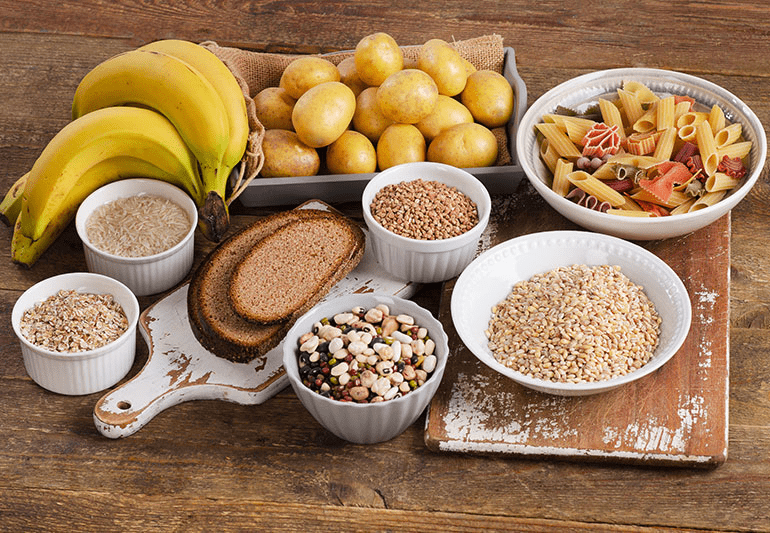
Suitable options might include:
-
Rice
-
Pasta
-
Potatoes
-
Bread
-
Oats
-
Cereal
-
Fruit
-
Rice cakes
-
Sports drinks when appropriate
The amount and timing should depend on the athlete, the session, gastrointestinal tolerance, and how much time is available before training.
A large meal immediately before hard sparring is obviously very different from a meal consumed several hours beforehand.
During Training
Carbohydrate intake during training is not necessary for every session.
For a short technical session, water and normal daily nutrition may be sufficient.
However, carbohydrate becomes more relevant when training is prolonged, particularly demanding, or when multiple sessions are performed with limited recovery time.
Sports drinks and other easily digested carbohydrate sources can be useful in these situations because they can simultaneously contribute to carbohydrate and fluid intake.
After Training
Post-training carbohydrate becomes particularly important when rapid recovery is required.
If another demanding session is scheduled later that day, restoring carbohydrate availability becomes a greater priority than when the athlete has a full day or longer before the next difficult session.
This is why nutrition should not be separated from the training schedule.
What Happens During Fight Camp?
Fight camp creates a difficult nutritional problem.
The athlete may simultaneously need to:
reduce body mass + maintain training quality + recover + preserve lean tissue + prepare for competition.
Simply eating as little as possible is therefore not an intelligent strategy.
Energy intake may need to decrease to facilitate gradual body-mass reduction, but the distribution of macronutrients still matters.
The 2025 International Society of Sports Nutrition position stand on combat sports recommends prioritising protein during longitudinal weight descent while maintaining carbohydrate availability to support training demands. The position stand suggests that carbohydrate should generally not fall below approximately 3–4 g/kg/day during fight camp, although individual requirements and strategies will differ.
For a 70 kg fighter, that reference range corresponds to approximately:
210–280 g carbohydrate/day.
This should not be interpreted as a universal prescription.
A fighter's requirements depend on training load, body composition goals, competition schedule, current energy intake, weight category, and the amount of weight that needs to be lost.
Fight Week Is Different
Fight week should not simply be treated as a more extreme version of normal dieting.
In some combat-sport situations, carbohydrate intake may be deliberately manipulated to reduce glycogen-associated body mass before weigh-in.
Recent combat-sport guidance suggests that glycogen manipulation may contribute approximately 1–2% of body-mass reduction in certain fight-week protocols.
However, this is an acute weight-management strategy, not an argument for chronically under-fueling during an entire training camp.
Following weigh-in, carbohydrate intake becomes important again as the athlete attempts to restore fuel availability before competition.
The appropriate strategy depends heavily on the time between weigh-in and competition.
A fighter with only a short recovery period has a very different situation from a professional fighter with approximately 24 hours or more available.
The Mistake: “Carbs Make You Fat”
Carbohydrates do not need to be viewed as either “good” or “bad.”
They are a tool.
Too much total energy over time can interfere with body-composition goals.
Too little available energy and carbohydrate during demanding training can make it harder to adequately support performance and recovery.
The goal is therefore not:
eat as many carbohydrates as possible.
And it is not:
remove carbohydrates to make weight.
The goal is:
Match carbohydrate availability to the demands of training while managing total energy intake according to the athlete's goals.
Practical Takeaway
For most fighters:
Hard training day → greater carbohydrate demand
Light training day → potentially lower carbohydrate demand
Multiple sessions → greater emphasis on recovery and carbohydrate replacement
Fight camp → manage total energy while maintaining enough carbohydrate to support training
Fight week → any deliberate carbohydrate manipulation should be planned separately from normal performance nutrition
Nutrition should support the work the fighter needs to perform.
Making weight matters.
But arriving at competition able to perform matters too.
References
Ricci AA, et al. International Society of Sports Nutrition position stand: nutrition and weight cut strategies for mixed martial arts and other combat sports. Journal of the International Society of Sports Nutrition. PMID: 40059405.
Januszko P, Lange E. Nutrition, supplementation and weight reduction in combat sports: a review. AIMS Public Health. 2021. PMID: 34395698.
Brechney GC, Cannon J, Goodman SP. Effects of Weight Cutting on Exercise Performance in Combat Athletes: A Meta-Analysis. International Journal of Sports Physiology and Performance. 2022. PMID: 35523423.
Franchini E, Brito CJ, Artioli GG. Weight loss in combat sports: physiological, psychological and performance effects. Journal of the International Society of Sports Nutrition. PMID: 23237303.
These are the references used to create this article. Fight Fuel Nutrition aims to translate current sports nutrition research into practical information for combat sports athletes.
Disclaimer: This article is for educational purposes and does not replace individual medical, dietetic, or clinical advice.